
Think about the role you were hired for. Now think about the work you actually do today. For many people, those are already two quite different jobs sharing the same title. That is why adaptability in leadership has never mattered more.
Korn Ferry’s latest Talent Trends report, based on a survey of more than 1,300 talent and senior leaders across over 75 countries, suggests this gap will only widen in 2027. The skills organisations need are shifting faster than ever, and the advantage will go to the people, teams and organisations that can learn, adjust and put new skills to work quickly.
So it is no surprise that the report names adaptability as the most wanted skill for 2027, ahead of critical thinking, collaboration, problem solving and communication. The question for every leadership team is a practical one: can adaptability actually be developed, and if so, how?
One figure in the report stands out. Only 6% of respondents believe their senior leaders are fully prepared to guide their organisations through AI driven change. I explored the human side of this in What Does Psychological Flexibility Have to Do With AI Anxiety?.
When senior leaders are still working out the direction, the uncertainty lands with managers. They are the people who have to explain to their teams what is changing, what it means for their work, and what happens next, often without clear answers themselves. Korn Ferry describes managers as becoming “the shock absorbers of the organisation”. Gallup has also shown how much of team engagement rests on managers, as I wrote in Why Managers Fail.
The report expects managers to spend more of their time guiding teams through change and less time managing day to day tasks. That is a very different job from the one most managers were trained for. It asks them to stay steady, honest and present when they cannot say exactly where things are heading, and to be comfortable saying “I don’t know yet”.
That is not a technical skill. It is a psychological one.
Korn Ferry describes adaptability as something that shows up less in big pivots and more in small course corrections: the judgement calls people make when there is no clear answer yet.
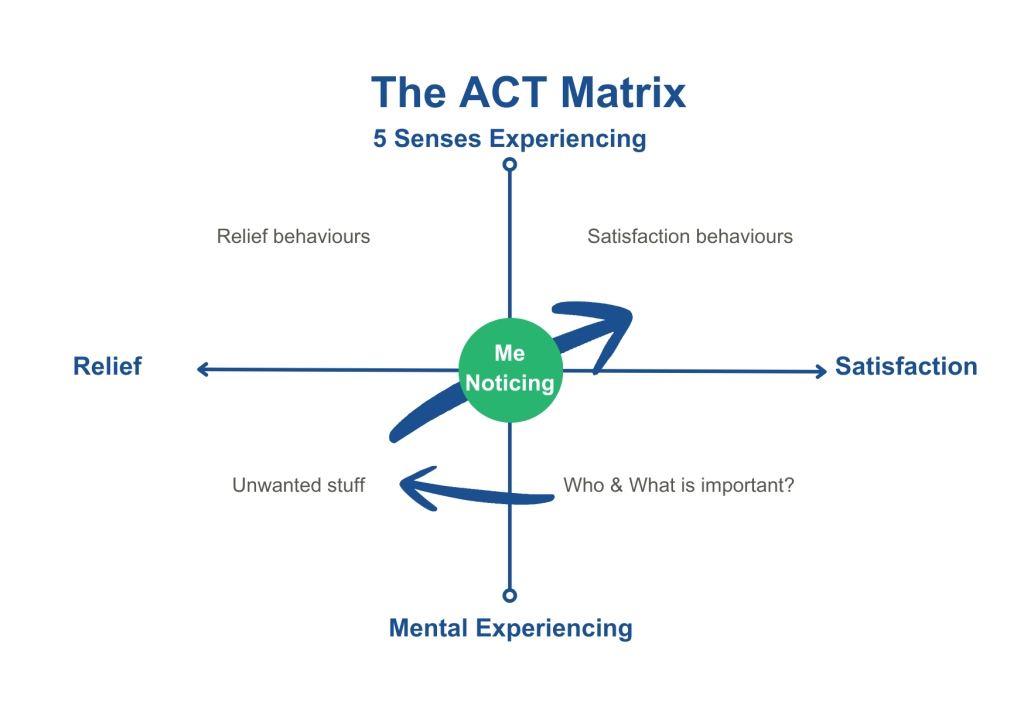
In my work, I call this psychological flexibility. It is the ability to keep doing what is important to live a satisfied life, even in the presence of the unwanted stuff: the doubt, the frustration, the worry about getting it wrong. When people are psychologically inflexible, they get stuck. They fall back on old habits or spend their energy trying to make uncomfortable feelings go away, and they stop noticing the other options open to them.
The good news is that psychological flexibility can be learned. It sits at the heart of Acceptance and Commitment Therapy (ACT), an evidence based approach, and research has consistently linked greater psychological flexibility with better wellbeing, job satisfaction and performance.
I use the ACT Matrix, created by clinical psychologist Dr Kevin Polk, to help leaders build this skill in a simple, practical way. The Matrix helps people notice what matters to them, notice what shows up inside them when things get difficult, and notice whether their behaviour is moving them towards satisfaction or towards short term relief. With practice, leaders begin to see more choices in the moment and choose behaviours that work better for them and for their teams.
Adaptability is not only an individual skill. The report makes the point that people adapt more quickly when they do not have to work everything out alone, and that leaders need to create a culture where people feel able to ask questions and work through change together.
That is another way of describing psychological safety: a team climate where people can speak up, admit mistakes, raise concerns and try new things without fear of being judged or blamed. Without it, people keep their uncertainty to themselves, problems surface late, and change stalls. You can read more in Why Psychological Safety Starts With Psychological Flexibility.
The Korn Ferry report also notes that collaboration is one of the skills we talk about least, even though it is crucial for leaders who want to drive change.
To help leaders build psychological safety, I teach them to use the ProSocial Matrix, also created by Dr Kevin Polk. It gives teams a shared, simple language for talking about what matters to them, what gets in the way, and how they want to work together. Teams that use it find it easier to have honest conversations and to move through change as a group rather than as individuals.
One of Korn Ferry’s recommended actions is simple: assess adaptability rather than guess at it. Before investing in development, it helps to know where your leaders’ strengths already lie and where support would make the biggest difference.
This is where I use the Trait Emotional Intelligence Questionnaire (TEIQue) from Thomas International. It measures emotional intelligence across 15 facets, including how people cope with pressure, how well they regulate their emotions, and how they relate to others. Each leader receives a detailed report and a one to one feedback session, which gives them a clear, personal starting point for their development. An anonymous team profile can also show a leadership team its collective strengths and gaps. I explain more in 5 Proven Ways the TEIQue Helps Your Leaders.
There is a strong business case, too. Korn Ferry’s Workforce 2026 survey found that 65% of workers would stay in their job if it offered learning and development opportunities. Investing in your managers is not only about helping them cope with change. It is also one of the most effective ways to keep good people.
If you lead an organisation or an HR team, here are four questions worth asking as you plan for 2027:
The world of work will keep shifting. The organisations that thrive will be the ones whose people can keep moving towards what matters, even when the path is unclear.
If you would like to talk about how emotional intelligence assessment, the ACT Matrix or the ProSocial Matrix could support your leaders and managers through the year ahead, I would be very happy to have a conversation.
Source: Korn Ferry, Talent Trends 2027: Skills Shifting. Korn Ferry’s 13th annual survey of more than 1,300 talent and senior leaders in over 75 countries.
Julie Allen is a Leadership Development and Organisational Wellbeing Consultant based in Northern Ireland. She is the only Certified ACT and ProSocial Matrix Facilitator on the Island of Ireland, and is an Internationally Certified user of Thomas International’s Trait Emotional Intelligence Questionnaire (TEIQue). She works with leaders and organisations across the private, voluntary and community sectors to build emotional intelligence, psychological flexibility, and genuine team connection.
Get in touch for a complimentary 15 minute consultation. No obligation, just a conversation about what your team needs.